

AI is changing our search behavior. You’ve probably heard this a million times. But we often think that it’s happening somewhere else, not in our industry.
Well, guess what? AI search optimization is very real in HR and recruitment. So, whether you’re an employer or a candidate, if you aren’t optimizing for AI systems, you’re significantly lowering your chances of being discovered.
To avoid that, in today’s guide, we’ll figure out how to optimize for AI search to improve both employer visibility and candidate discovery.
Why Traditional Recruitment SEO Is No Longer Enough
Look, we want to be clear here: even if you aren’t optimizing for AI-generated search results, you can still find your candidates and fill open roles. The articles that tell you you’ve already lost are really exaggerating it. Because you can still find talent on LinkedIn or platforms like jobbers.
But there is an important but. 51% of organizations already use AI-powered recruitment. And 89% of them say it saves them time and increases their efficiency.
So, if you don’t reconsider your current approaches, you will be behind them eventually.
There is also good news, though. If you’ve been doing your recruitment SEO well, getting good AI search rankings will generally be much easier.
Because once you see how to rank in AI Overviews and LLMs, you’ll realize that it’s about having a strong SEO foundation with a couple of additional adjustments.
How Candidates and Employers Use AI Search in 2026
The job market is different, not because everyone is talking about AI-related skills, but because both candidates and employers get discovered differently.
Candidates
For many candidates, job search isn’t as traditional as it used to be. It’s not just about going to Indeed, LinkedIn, or freelance platforms and scrolling through what’s out there.
Candidates ask AI chats about:
- Best workplaces,
- Companies that have relevant openings,
- Jobs that are a good fit for them,
- Salary ranges and benefits,
- Opinions of ex-employees that they share online, etc.
And AI doesn’t give them 20 pages of search results, as Google would. LLMs suggest a couple of things that they think fit best.
And that’s exactly why companies have to pay more attention to their search discovery in both traditional and AI search. Because if your business doesn’t make it into those few suggestions, it will be invisible.
Employers
Employers, on the other hand, do everything possible to analyze as many candidate profiles as quickly as possible. That’s why there is such a rise in AI hiring tools.
Overall, companies and recruiters use AI to:
- Look for relevant candidates on different platforms,
- Filter through their existing databases,
- Pre-screen the CVs and applications,
- Summarize interviews,
- Analyze different details, including test tasks, portfolios, and so on.
That’s why candidates have to be particularly focused on providing as many relevant details as possible in the most digestible format.
AI-Powered Recruitment: How Employers Can Optimize for LLMs
Now, let’s take a look at the exact tactics companies can use to make their job listings more discoverable.
1. Write Specific and Structured Job Postings
If there is one thing AI systems love, it’s structure. When your content is scannable, it’s easier for candidates to understand what you need. But LLMs also prefer this structure, as it helps them to parse the page and find important information.
So, whenever you create a job posting, keep this in mind and make sure you:
- Have clear headings for Requirements, Skills, Responsibilities, Hiring process, etc. Don’t try to squeeze everything into one section.
- Clearly define must-have and optional skills.
- Use bullet points and numbered lists.
- Specify all the basic details (location, experience, remote or not, etc.).
- Use widely spread terms and names, and avoid any useless, non-descriptive words, like “seasoned,” “world-class team,” etc. Be specific, and where possible, add proof.
2. Work on Your External Brand Signals
If you look at the AI answers, they are different from Google’s search results. In fact, on average, only 12% of links cited by LLMs show up in the top 10 results for the same prompt.
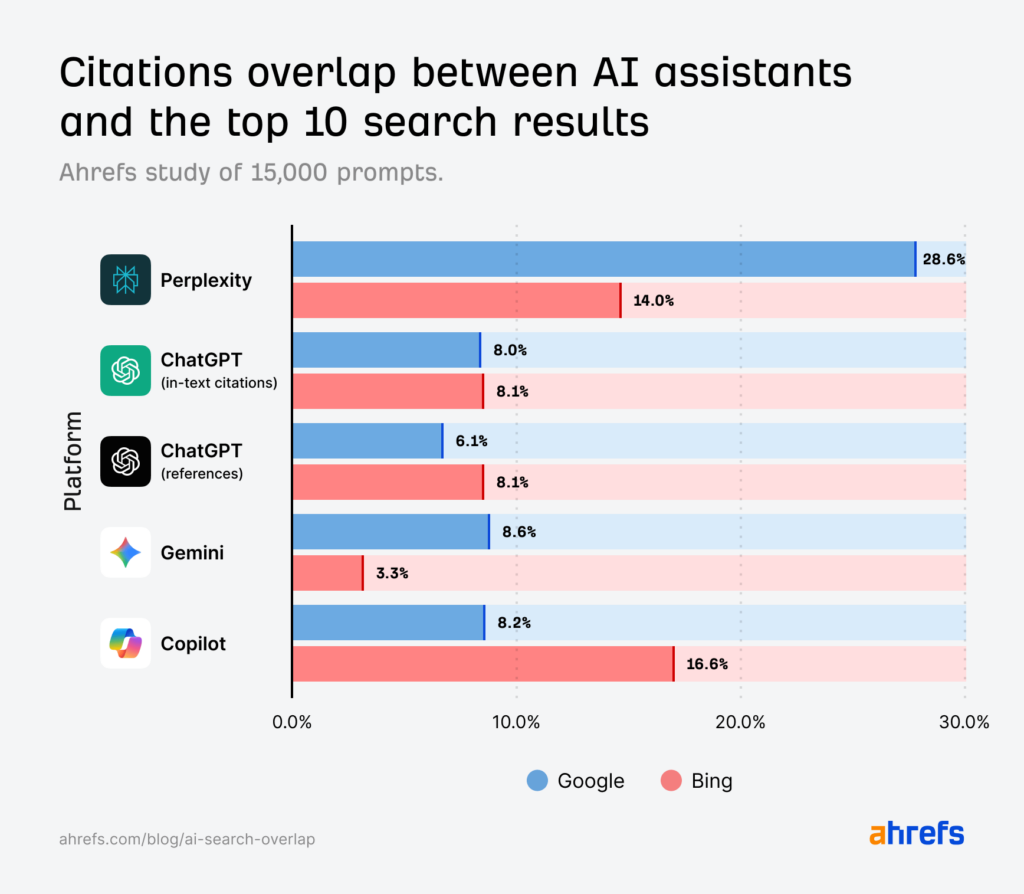
This is huge, as it means that AI doesn’t only rely on traditional search rankings. What does it rely on, then? One of the major factors that influences your AI discoverability is the overall visibility of your brand.
So, when building an employer branding strategy, you have to make sure that you get a lot of external exposure. This can include press releases, awards, guest articles, columns, mentions on forums (including Reddit and Quora), a strong Glassdoor profile, citations in “X best employers” listicles, etc.
3. Create Relevant Recruitment Content
While most businesses treat their websites as a client acquisition channel, it’s more than that. Your website is also important for both organic candidate acquisition and AI recruitment lead generation.
It’s hard to imagine any serious candidate who wouldn’t check your website at least at some point in the hiring process. But it also matters for AI search.
When a person asks anything about your company, the first place where LLMs typically search for answers is your website. And if you don’t have any relevant information, AI systems can cite something inaccurate.
So, it’s in your best interest to add at least some of these pages to your website:
- Your hiring process,
- Your culture and team details,
- Any career path content (maybe including your current employees’ stories),
- FAQs for the interview procedure and any other details a candidate may be interested in,
- Well-structured and optimized job postings with lots of relevant details, etc.
4. Use AI Recruitment Tools Without Fully Relying on Them
All types of AI hiring tools have been a real trend lately. And it’s totally understandable, considering the amount of time they can save. Some of the most popular use cases for them are:
- Candidate search. They can go through your internal databases, LinkedIn, job posting platforms, and any other candidate pools to find those that best match a required skillset.
- Pre-screening. They can also help you analyze the resumes and match them to the job requirements.
- Interview analysis. You can easily transcribe and summarize interviews, highlighting the important parts.
- Communication automation. This refers to anything from scheduling interviews and automatically answering typical questions to sending follow-ups and running chatbots.
- Hiring process optimization. These tools can also help you analyze and improve your internal processes. You can understand how long it takes to find the right person, where the bottlenecks are, etc.
While it seems like you can delegate everything to AI recruitment tools, it isn’t the best idea. While they can help you organize your workflow, they can’t tell you who’s a better fit for your company specifically.
In recruitment and HR, human-to-human interaction is crucial. And you can’t assume that AI can replicate that.
How Candidates Can Make Their CV and Profile AI-Readable
What about candidates? How can you make your CV not only HR- and recruiter-friendly but also AI-friendly? Let’s figure that out.
1. Keep a Clean Structure
Whether it’s your CV or profile on LinkedIn or any job board, you have to make it clean. A good rule of thumb is to glance at your resume for 5-10 seconds and check whether you can easily find all the important information.
Your main goal is to structure it in a way that a recruiter or an AI system knows where to look for the specific details. To make that happen, remember these simple tips:
- Add a clear section with all the basic data (contact details, location, a clear job title, etc.).
- Have separate sections for skills and tools you know how to use.
- Describe your work experience from the most recent one to the oldest one. Only include relevant experience, specify the timeframe, and add your responsibilities.
- Make sure you have a section where you show your results or portfolios (where applicable). This is an essential part to prove that you can deliver results, not just show up to work.
A good tip after writing your CV is to use any LLM you prefer and ask it to critique the structure. This way, you’ll get some suggestions that can help you polish your resume.
2. Use Keywords and Widespread Terms
Even if you’re applying for a creative job, your CV isn’t the place for experimentation. So, it’s very important to keep it informative first, and unique second.
As much as possible, try to:
- Avoid any exquisite language and literary devices,
- Use widespread terms for your job title, skills, workflows, etc.
- Add some keywords (search terms) that you think recruiters will prioritize for your position.
The point here is to make your resume match what the hiring company on the other side would look for. So, go through several job postings you want to target and literally write down the language they use.
This is the best way to match what recruiters need. And it’s also one of the most effective things you can do for AI search optimization because you’re clear and relevant.
3. Describe Your Experience in Detail
When you review the job postings you are interested in, you’ll often see very clear requirements and skills. Your goal is to show that you have that exact experience the companies need.
So, avoid simply writing things like: “I was managing XYZ projects, from idea to release.”
Instead, be very specific: “I was managing X project (describe it briefly). There were X people involved (who they were). I was responsible for X, Y, Z tasks (make it very clear). As a result of my work, we managed to X (specify the exact outcomes, where possible, with numbers).”
When you do this for every place you worked for, AI systems will have enough details to pull from and suggest your profile as a strong match.
Besides, if you’re working on your personal brand, make sure to mention it as well. It can be a really great bonus point. Explain how you got there, what feedback you got, how it helped you become a better professional, etc.
Conclusion
When it comes to AI search optimization for both employer visibility and candidate discovery, you have to be very specific. LLMs are essentially algorithms. And they won’t look at your profiles like they “have a gut feeling,” and they could give you another chance.
It’s just not what they do. So, the best approach is to make sure your structure is crystal clear and that you build at least some digital presence and authority signals, especially for companies.
Once you give AI systems enough well-structured details to work with, you will be one step ahead of everyone else. Because while recruitment SEO is still here and still relevant, it has gotten even more organized. And you have to match that to stay relevant.
Create your freelance profile
Join Jobbers and start applying to projects today. No commission.