

Reviewed by the Jobbers.io editorial team · Data last verified August, 2026.
Not long ago, the question was simple: can you find someone to fill the role, or not? In 2026, it’s gotten more complicated. Business owners and IT managers now juggle several sourcing paths at once, sometimes for the same open position. A help desk seat might sit open for weeks while a company decides whether to post it on a freelance marketplace, hand it to a recruiter, or try to hire in-house one more time.
This piece is for the business side of that decision, not the freelancer side. If you’re weighing a freelance IT marketplace against a dedicated staffing and recruitment path for your next hire, the right answer usually depends on what kind of work you’re actually trying to get done.
Why the IT Talent Gap Is Forcing New Hiring Strategies

The numbers behind this shift are hard to ignore. According to the Kaseya 2026 State of the MSP Report, the share of MSPs reporting difficulty hiring skilled technicians nearly doubled year over year, climbing from 9% in 2025 to 16% in 2026. Separately, DeskDay’s Top 12 MSP Trends 2026 analysis found that 52% of MSPs identify hiring as their primary internal challenge, and LTVplus’s analysis of the Kaseya data puts average technician sourcing time at 12 to 16 weeks.
It’s not just MSPs feeling the squeeze. The U.S. Bureau of Labor Statistics projects that employment of computer support specialists will decline 3% from 2024 to 2034, yet still generate roughly 50,500 openings a year due to turnover and replacement need alone. CompTIA’s State of the Tech Workforce 2026 report puts the broader U.S. tech workforce on track to grow 1.9% in 2026, adding about 185,499 new jobs, with replacement demand driving roughly 323,000 openings a year through 2036.
Faced with numbers like these, many organizations have stopped trying to solve hiring entirely on their own. A growing number turn to MSP recruitment companies that specialize in vetting and placing remote IT technicians, treating recruitment as a specialized function rather than something a stretched-thin internal team handles between tickets. It’s a practical response to a market where in-house hiring now averages 41 days from job posting to signed offer, up 24% from 33 days in 2021, according to Gem’s 2025 Recruiting Benchmarks Report.
Two Paths to Filling IT Roles: Freelance Marketplaces vs. Dedicated Staffing
Once a business accepts that it can’t out-hustle the market alone, the next decision is which path fits the work in front of them. Broadly, two models dominate: freelance marketplaces and dedicated staffing or recruitment firms, and they solve different problems.
Freelance marketplaces, like Jobbers.io, are built for project-based work with a defined scope and a clear end point. A company needing a one-time cloud migration, a security audit, or a short DevOps sprint can post the job, review candidates, and get moving within days. Jobbers.io is worth mentioning here because it takes a different approach than many marketplaces in this space: it doesn’t take a commission on the work, and it lets freelancers and clients discuss payment terms directly rather than routing everything through a platform fee structure. That matters for businesses trying to control costs on a fixed budget.
Dedicated MSP staffing and recruitment firms solve a different problem: ongoing, ticket-based support that needs consistent coverage, accountability, and often compliance handling that a business doesn’t want to manage in-house. The IT staffing market itself reflects this demand. Mordor Intelligence projects it will grow from $123.30 billion in 2025 to $127.75 billion in 2026, reaching $152.47 billion by 2031, a 3.61% compound annual growth rate. That’s a sizable, growing industry built specifically around solving the staffing problem for companies that don’t want to run recruitment themselves.
Our complete guide to building a freelance IT career covers what that path looks like from the freelancer’s side of the hiring table.
When Freelance Marketplaces Make Sense for IT Work

Freelance marketplaces tend to work best under a specific set of conditions. A defined start and end date usually beats a longer recruitment cycle. A specialized, short-term skill, such as a one-off cloud migration or a penetration test, rarely justifies a full-time hire. And when budget flexibility matters more than long-term management overhead, a freelance engagement keeps costs tied directly to output rather than salary and benefits.
Rate transparency also plays a role. Our own rate guide for cloud and DevOps freelancers breaks down what specialized technical freelancers are charging in 2026, giving businesses a realistic budget benchmark before they post a project.
Where freelance marketplaces fall short is anything that needs sustained daily coverage. A single freelancer, however skilled, isn’t a substitute for a help desk team that answers tickets around the clock.
When Dedicated MSP Recruitment Makes Sense
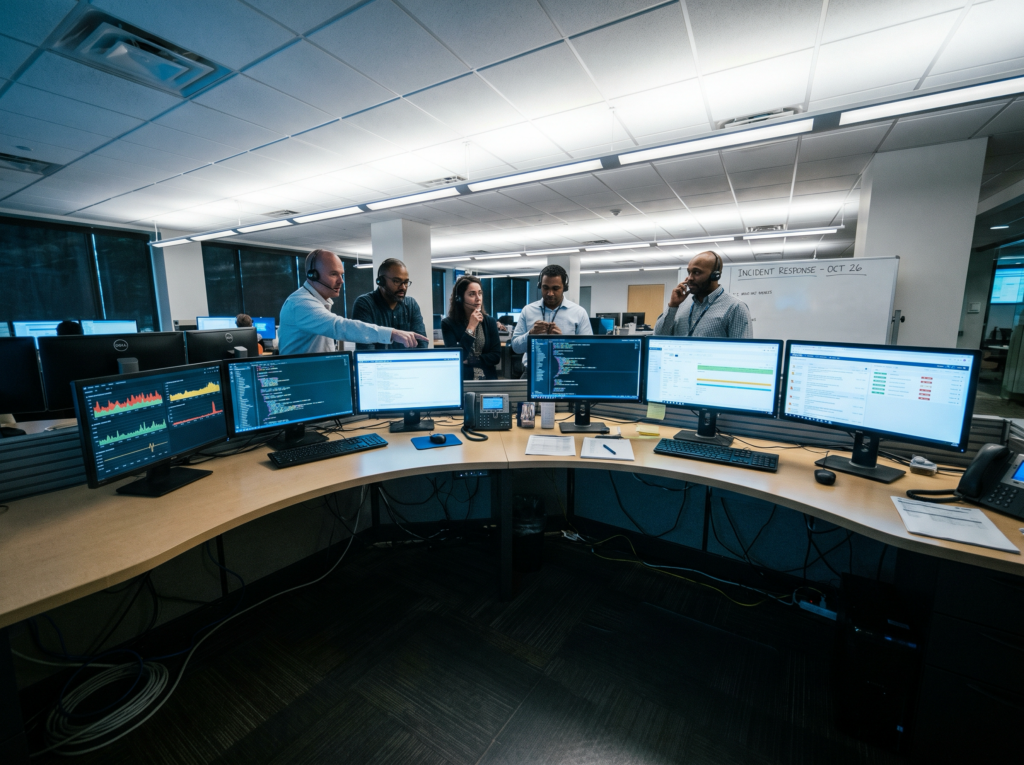
Dedicated staffing makes more sense once the work becomes ongoing rather than project-based. Help desk coverage, day-to-day monitoring, and client-facing support roles all need people who show up consistently, follow established processes, and stick around long enough to build institutional knowledge about the systems they support.
This is also where compliance and HR overhead become a real factor. A staffing partner that handles vetting, payroll, and onboarding removes administrative work that would otherwise fall on an already-stretched internal team. Given that Kaseya’s data puts average technician sourcing time at 12 to 16 weeks, it’s easy to see why many businesses would rather outsource that function than run it themselves every time a seat opens up.
Combining Both Models: A Blended Workforce Approach
The more interesting trend in 2025 and 2026 isn’t businesses choosing one model over the other. It’s businesses using both at once. A company might keep a dedicated MSP staffing relationship for its core help desk team while tapping freelance talent for occasional specialized projects that don’t justify a permanent hire.
This blended approach tracks with a broader move toward flexible, contingent workforce strategies across the tech sector. It’s a portfolio approach to staffing, where the sourcing method matches the type of work rather than defaulting to whatever channel a company used last time. Our comparison of freelance marketplace platforms covers 15 options beyond Jobbers.io worth knowing about.
Questions to Ask Before You Choose a Hiring Path
Before committing to either route, run through a short checklist:
- How long is the work expected to last? A few weeks points toward freelance; ongoing coverage points toward staffing.
- Is the budget fixed, or does it need to flex with workload?
- Does the role require vetting, compliance, or payroll handling you’d rather not manage in-house?
- How urgent is the need? Freelance marketplaces often move faster for narrowly scoped work.
Outbound Resources for Further Reading
- U.S. Bureau of Labor Statistics, Occupational Outlook Handbook, Computer Support Specialists — government data on job openings and projected employment trends for IT support roles.
- CompTIA, State of the Tech Workforce 2026 — industry research on tech workforce growth and replacement demand.
- Mordor Intelligence, IT Staffing Market Report — market sizing and growth projections for the IT staffing industry.
- Kaseya, 2026 State of the MSP Report — survey data from over 1,000 MSPs on hiring difficulty and operational challenges.
- LTVplus, 10 Takeaways from the Kaseya 2026 State of the MSP Report — analysis of technician sourcing timelines drawn from the Kaseya data.
- DeskDay, Top 12 Managed Service Provider (MSP) Trends 2026 — data on hiring as MSPs’ primary internal challenge.
- Gem, 2025 Recruiting Benchmarks Report — benchmark data on time-to-hire across industries.
Disclaimer
The statistics, figures, and market projections cited in this article come from third-party industry reports current as of 2026. Market data changes frequently, and readers should independently verify all numbers, pricing, and figures before relying on them for business or financial decisions. This article is provided for general informational purposes only and does not constitute legal, financial, or professional hiring advice.
FAQ
What’s the difference between a freelance IT marketplace and an MSP staffing agency?
A freelance marketplace connects businesses with independent contractors for scoped, project-based work, typically with a defined start and end date. An MSP staffing or recruitment agency vets and places technicians for ongoing, ticket-based support roles that need consistent, long-term coverage.
Does Jobbers.io charge commission for hiring IT freelancers?
No. Jobbers.io does not take a commission on freelance engagements. Freelancers and clients discuss and agree on payment terms directly, without a platform fee cutting into the arrangement.
How long does it typically take to hire a skilled IT technician in 2026?
Sourcing timelines vary by hiring path. In-house recruitment now averages 41 days from job posting to signed offer, according to Gem’s 2025 Recruiting Benchmarks Report, while MSP technician sourcing can run 12 to 16 weeks according to analysis of Kaseya’s 2026 State of the MSP Report. Freelance marketplace hires can often move much faster for narrowly scoped project work.
Can businesses use both freelance platforms and MSP recruitment firms at the same time?
Yes. A growing number of businesses use a blended approach, relying on dedicated MSP staffing for ongoing help desk and support coverage while using freelance marketplaces for shorter, specialized projects that don’t require a permanent hire.
What is causing the IT staffing shortage in 2026?
Several factors are driving it: rising demand for skilled technicians, a shrinking pipeline of qualified candidates for certain support roles, and elevated turnover. Kaseya’s 2026 State of the MSP Report found that MSPs reporting hiring difficulty nearly doubled year over year, from 9% to 16%.
What kinds of IT work suit a freelance marketplace instead of MSP staffing?
Freelance marketplaces tend to work best for scoped, time-limited projects such as a one-time cloud migration, a security audit, or a short DevOps sprint. Work that needs sustained daily coverage, like help desk support or 24/7 monitoring, is usually better served by dedicated MSP staffing.
Is it cheaper to hire through a freelance IT marketplace or an MSP staffing agency?
It depends on the type of work. Freelance marketplaces tie cost directly to project output rather than salary and benefits, and on Jobbers.io specifically, there’s no commission, so freelancers and clients negotiate rates directly. MSP staffing agencies typically bundle vetting, payroll, and compliance handling into their fees, which can cost more per hour but removes administrative overhead for ongoing roles.
Conclusion
There’s no single right answer to the freelance-versus-staffing question. Businesses that treat it as either-or usually leave something on the table. The fastest-growing companies in 2026 tend to treat freelance marketplaces and dedicated MSP recruitment as complementary tools, matching the sourcing method to the type of work rather than defaulting to whatever channel they used last time. Given how tight the technician market has become, that flexibility is becoming the standard way businesses keep their IT operations staffed.
Create your freelance profile
Join Jobbers and start applying to projects today. No commission.